
What Fertility Doctors Wish You Understood About IVF
On Friday, Feb. 16, the Alabama Supreme Court ruled that several couples whose embryos had been destroyed when they were removed from a hospital freezer could sue for “wrongful death,” meaning the embryos are considered children in the eyes of the law.
The text of the ruling refers to embryos as “unborn life” and “extrauterine children,” arguing that each one is a person made in God’s image, per language enshrined in the state’s constitution.
Reproductive health care had already been curtailed in Alabama, which has some of the country’s most restrictive legislation regarding abortion. Abortion procedures are banned entirely, with limited exceptions to protect the life of the pregnant person.
In the wake of this recent ruling, Alabama residents are already losing access to IVF. The IVF program at the University of Alabama at Birmingham has halted fertilizations and embryo transfers to protect doctors and patients from legal repercussions.
Hannah Echols, a spokesperson for the university, told HuffPost this week: “We are saddened that this will impact our patients’ attempt to have a baby through IVF, but we must evaluate the potential that our patients and our physicians could be prosecuted criminally or face punitive damages for following the standard of care for IVF treatments.”
On Thursday, another clinic, Alabama Fertility Specialists, publicly announced that they, too, would halt their services. In their Facebook post announcing what they called an “impossibly difficult decision,” they wrote, “we are working as hard as we can to alert our legislators as to the far reaching negative impact of this ruling on the women of Alabama.”
On Friday, The Guardian reported that nationwide shipping services have announced they will no longer transport frozen embryos to or from the state of Alabama, closing off Alabama patients’ last hope of accessing embryos that have been kept out-of-state, or having embryos shipped to another state in order to perform embryo transfers there.
Barbara Collura, president of RESOLVE, an organization that advocates for fertility patients, said in a statement, “We have heard from countless distraught would-be parents over the past several days — the devastation wrought from this ruling is incalculable.”
To understand the full reach of this ruling and how it’s flawed logic will harm patients, HuffPost spoke to two reproductive endocrinologists — fertility doctors who provide IVF. Dr. John Storment of Louisiana called the ruling “appalling,” and Dr. Alexis Melnick, who practices in New York, deemed it “scary.” Below, they explain their concerns and explore potential solutions.
The ruling could make it very difficult for fertility doctors to do their jobs.
“I think this is something that we’ve sort of all feared,” Melnick said of the ruling, adding that it was once a much more distant threat, but drew closer in the wake of Dobbs v. Jackson Women’s Health, the Supreme Court decision that revoked abortion rights at the national level in 2022.
The first baby conceived in vitro was born in 1978, just five years after Roe v. Wade, and the procedure has become relatively common and much safer in the decades since. While IVF often used to result in multiple pregnancies (twins and triplets), which pose risks to both mother and babies, technological advances have made single-embryo transfer the norm.
In an IVF cycle, doctors stimulate a patient’s hormones so that they produce multiple eggs (or oocytes — female reproductive cells). The number of eggs a patient produces varies tremendously based on their age and the dosing of different medications. Some patients do not produce any viable eggs, while others produce dozens. Storment said that getting 15 eggs from one stimulation cycle is not unusual.
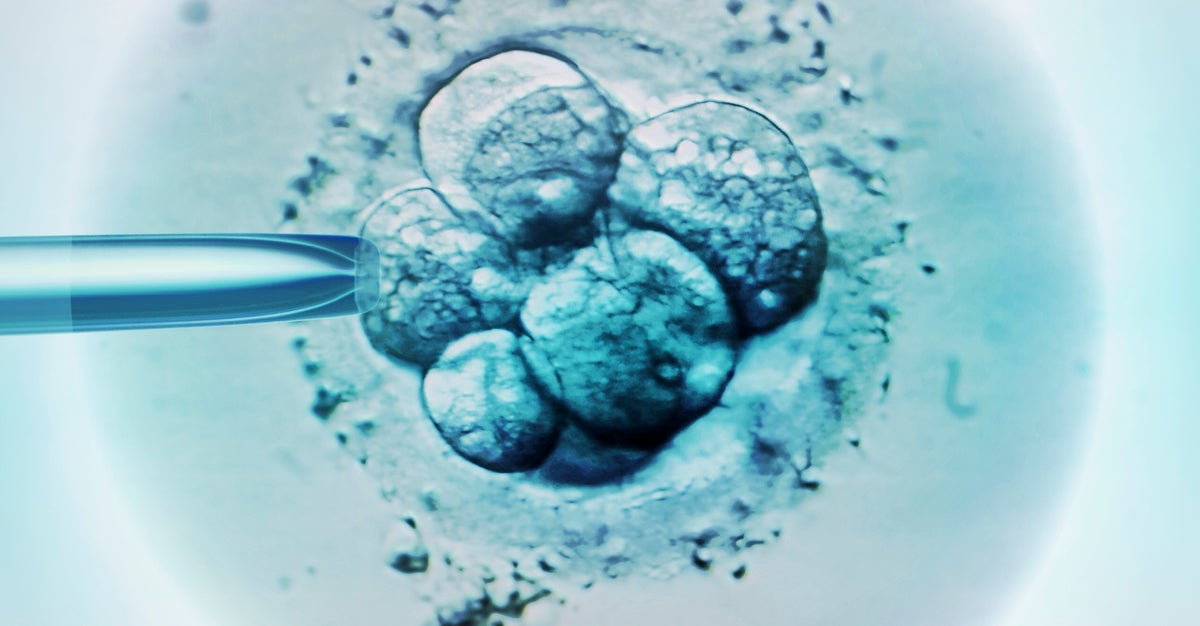
An embryologist then fertilizes the viable eggs with sperm (male reproductive cells) from the patient’s partner or donor. The hope is often to create multiple embryos, which can be frozen and transferred one at a time into the patient’s uterus. Each viable embryo is a potential pregnancy, and more embryos mean more chances that the cycle will result in a live birth.
(Not every embryo transfer leads to a pregnancy, as the doctors explained to HuffPost below.)
If embryos are suddenly considered children, however, doctors and embryologists would need to restructure the process completely, freezing the patient’s eggs before fertilization and thawing them one by one to fertilize them. If a viable embryo results, doctors would then transfer it into the patient’s uterus.
“What that means is tremendous inefficiency for patients,” Melnick said, as well as “tremendous cost,” both financial and emotional.
A second option would be to fertilize multiple eggs and transfer multiple embryos into the patient’s uterus, which would mean more high-risk multiple pregnancies, as in earlier eras of IVF.
The Alabama ruling also poses huge liability concerns for doctors. “I could imagine big institutions just wanting to be very careful, protecting themselves,” Melnick said, adding that she was not surprised to learn of IVF clinics in the state coming to a standstill.
“I don’t see any way out of it for the doctors in Alabama and I feel extremely bad for them to the point where I probably wouldn’t stay, based on that law,” Storment said.
If fertility doctors decide to leave Alabama, it will continue a pattern of new health care restrictions draining providers from the state. After Dobbs, Alabamans lost all access to abortion care, and parts of the state are considered maternity care “deserts,” where patients have to drive long distances to find obstetric care. Last year, several hospitals closed their labor and delivery units.
It could also make the storage of embryos a challenge.
When embryos are taken across state lines into Alabama, they could go from being viewed as human tissue to having the rights of a child. Storment explained that his clinic stores embryos at a facility in Nevada.
“If an entity is storing embryos, they have to have insurance for liability, and nobody will insure them to keep embryos on site if they look at it as a baby,” said Storment.
Melnick noted that when Dobbs was decided, there was a wave of patients who moved their frozen embryos to states without restrictive abortion laws, to protect against this sort of potential reclassification.
Embryo donation, a path to parenthood for some families, would be threatened.
Currently, patients who have extra embryos in storage that they do not plan to use have several options. They can continue pay to store them indefinitely, have them discarded, donate them to science (the Alabama ruling would prohibit those two options) or donate them to another family that wants to have a child.
Storment said of this sort of embryo donation, “Honestly, it’s one of the most rewarding things that we do.”
“Now that they’re [considered] children, you’re going to have to have a whole different set of attorneys,” he explained, as transferring custody of a child for adoption is a very different legal process than donating an embryo. And after all of this, there is never a guarantee that an embryo will result in a live birth.
Most naturally-conceived embryos do not become babies, and the same is true for IVF.
Defining an embryo as a child shows a lack of scientific literacy and a fundamental misunderstanding of the way that human reproduction works, the doctors HuffPost spoke to said.
“Human reproduction is very inefficient and wasteful. The chance of the most fertile man and fertile woman making a baby in any given month is 20%,” Storment explained.
Some embryos never attach to the uterine lining or are miscarried, usually early in the pregnancy. In many of these cases, the embryo’s brief existence is never even known to the parents.
IVF can enable many couples to become pregnant, but it cannot fundamentally change these odds. Most embryos won’t stick. “The majority of embryos that are created, either naturally or through IVF, are not going to lead to babies,” Melnick said. This is the reason that doctors generally aim to create multiple embryos per IVF cycle.
In the best-case IVF scenario, when testing shows an embryo to be genetically normal, its odds of resulting in a pregnancy are still under 70%.
Embryos are not babies, but they are treated with respect by doctors.
Storment said he is frustrated by laws that “equate an embryo with a child.”
“A child has trillions of cells, an embryo has a hundred cells, and there’s so many more things that have to occur for an embryo to become a child,” he said.
At the same time, an embryo isn’t nothing. Storment called it “a unique collection of cells that has the potential for a human being.”
Both Melnick and Storment emphasized the respect and care with which doctors, embryologists and patients treat embryos. Accidents like the one in the Alabama case are rare.
“There’s this idea that IVF is very irresponsible and that embryos are treated very frivolously, [that] people who are using IVF may not need to be doing IVF, and I think that that’s really not true,” Melnick said. She noted that her patients use IVF not only for infertility but to protect their families from the impact of devastating genetic diseases.
Legal workarounds are possible.
Storment explained that in Louisiana — which, like Alabama, now bans abortion in almost all cases — doctors found a workaround for anti-abortion activists’ concerns about IVF years ago.
The late Dr. Richard Dicky, a pioneer of fertility medicine in the state, met with some Louisiana legislators. When he asked what their issue with IVF was, they said, ”‘We don’t like freezing and discarding embryos,’” as Storment recounted. Dicky proposed that lawmakers simply outlaw discarding embryos instead.
For decades, Storment explained, Louisiana has had the only state law that prohibits discarding embryos. “They allow the patients to transfer their embryos out of state, if they want to discard or otherwise.”
While an “inconvenience,” he said, the law has “actually not been a hindrance.”
Melnick also expressed optimism that “IVF will always be here,” although keeping it available to patients may require “a lot of extra work, energy, stress, that really takes away from the ability to serve the patients.”
Leave a Reply