
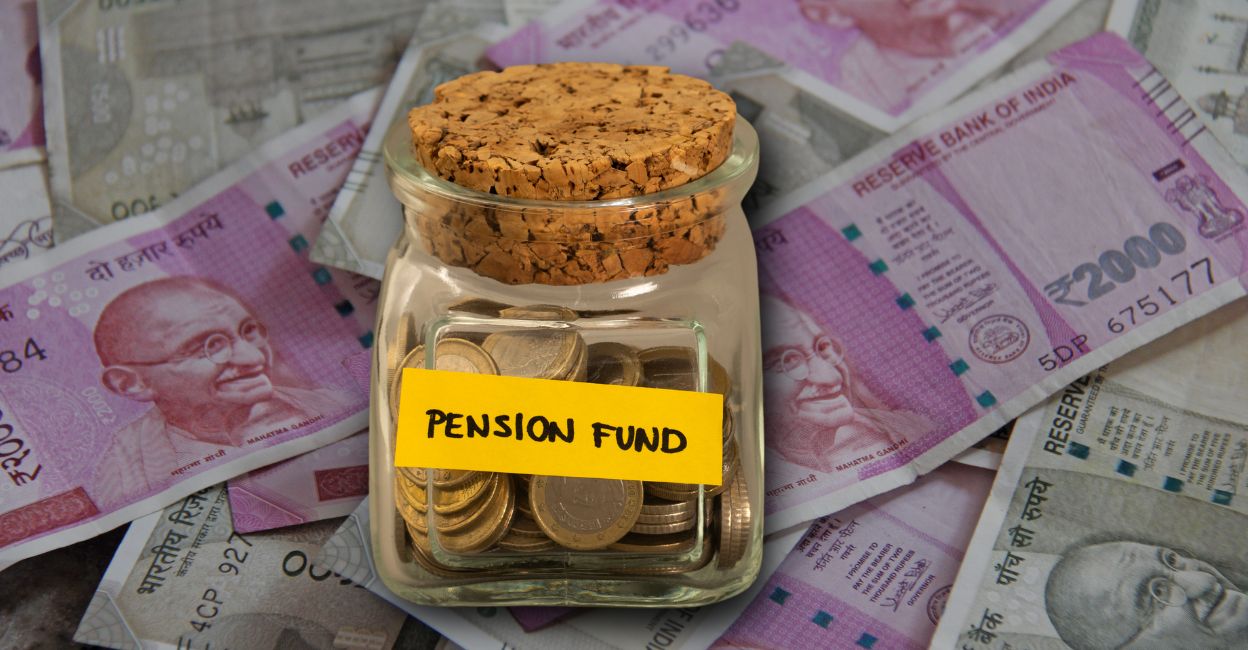
NPS makes financial sense. But will electoral politics retire OPS?
For a long time, the common man was carrying government employees and pensioners on his shoulders -– much of the taxes he paid ended up with the current and former government employees as salaries and pensions. The New Pension Scheme of 2004, which is now the National Pension System or NPS, was an attempt to get one of them, the current government employees, who are the future pensioners, off the common man’s back.
Of late efforts are on to get the government employees back onto the shoulders of the common man by bringing back the unfunded old pension scheme, or OPS. Ironically. One of the staunchest supporters of the old system is AAP, literally the common man’s party.
Away from NPS
Its recipients love OPS – 50% of last drawn salary as pension, no deduction from salaries, and inflation protection through regular dearness allowance (DA) increases. And if you’re lucky, your pension may even be revised upwards if the government so decides.
So what about NPS? It means a deduction of 10% from each month’s salary, no inflation protection, and most importantly a pension with no link to the last salary, which cannot be known in advance and left to the vagaries of financial market returns. And no provision for an upward revision.
Some initial NPS retirees who opted for the new system in their late 40s and early 50s, mostly with service periods of around a decade, get a paltry payout.
And for the governments paying under OPS? Currently, state governments pay pensions to retired employees under OPS and make employer contributions to current employees under NPS. Once you switch back to OPS, employer contributions need not be made which brings down current expenditure.
But this will come back to haunt the state finances when they retire later on with no earmarked funds for pension payment. Thus it is, in effect, kicking the can down the road. But OPS helps parties gain electorally. Even though government employment is available only to a small fraction of the population, a huge chunk of the electorate who will never get a government job is spellbound by its benefits
An analysis by Economic Times found that if all states switch to OPS, then by the financial year 2046-47, 40.5% of their tax revenues (which excludes tax transfers/grants from the Union Government) will be required to pay pensions. The survey found out that in FY 21-22, 25% of all states’ tax revenues went towards pensions with Himachal Pradesh leading the list with a whopping 80%.
If all states switch to OPS, then by the financial year 2046-47, 40.5% of their tax revenues (which excludes tax transfers/grants from the Union Government) will be required to pay pensions. Photo courtesy: PRD
Lured by NPS
While the government employees are clinging onto OPS, 1 million new staff from the non-government sectors have added to NPS in FY 22 – 23, which Businessline says is a record. Assets under management (AUM) of NPS in the corporate and all-citizen model grew 29% and 31%, respectively, in FY 22-23 to Rs 1.41 lakh crore and Rs 42,623 crore.
What’s attracting the non-government sector to NPS? The initial attraction was the income tax break for contributions. Now there is an added benefit of superior returns; NPS fund managers have earned 12-13% returns on equity and 8-9% on debt over the past 10 years which is more than EPF/bank deposit rates and inflation.
Moreover, NPS is now open and affordable to any adult below 65 years. Even a daily wage labourer or a gig worker can have an NPS account and keep the account live by remitting a minimum of Rs 1,000 a year. And unlike Employees Provident Fund, there are multiple fund managers to choose from along with portability which ensures competition.
A pampered lot
Government employees get job security and regular salary increases through DA hikes, annual increments, revisions by Pay Commission and promotions. Thus during working life itself, they get enough opportunities to acquire assets and investments. Then why do they need to be pampered beyond retirement with taxpayer-funded pensions? The usual reply is that pensions are deferred salaries. But this argument holds little water as no deduction is made from salaries towards the pension corpus.
To put it differently, when even a manual labourer and a food delivery boy have to put away a part of their income to earn a pension under NPS, why should government employees be excluded from contributing to their pension? Should the pensioner be paid from the GST paid by the daily wage labourer and food delivery boy?

While the government employees are clinging onto OPS, 1 million new staff from the non-government sectors have added to NPS in FY 22 – 23. File photo: Reuters
Gains from compounding
But what about low pensions for the early retirees under NPS? Gains from compounding are back-ended. A monthly investment of Rs 10,000 with a 10% return will be Rs 2.08 crore in the 30th year. But in the 10th and 20th year, the corpus will only be Rs 20 lakh and Rs 72 lakh, respectively. It will reach the Rs 1 crore mark only in the 23rd year but in the remaining seven years, another Rs 1.08 crore will be added!
And the returns (ignoring contributions) earned in the 30th year alone will be more than the corpus (contributions + returns) at the end of the ninth year! All this without considering the growth in contributions as salary grows. Thus someone putting in 30 years or more of service can expect a good pension.
India’s challenges
India is a lower-middle-income country on a per capita basis. But high inequality means a huge chunk of people have income way below the per capita level. India is also set to surpass China as the most populous nation this year but with a huge proportion of youngsters. To reduce poverty and reap the demographic dividend, substantial investments have to be made in education, healthcare and infrastructure so that the productive potential of these youngsters is converted into economic growth. Infrastructure and human capital is the foundation on which private sector investments are made. Hence, such public goods have to be provided by the government at subsidised rates or fully free of cost for everyone to benefit. Thus tax revenue is the only option
Then there is climate change. Losses from extreme climate events and reducing the carbon footprint entail huge expenditure and here too government has to take the lead.
We also have to deal with a belligerent and aggressive China which means stepping up defence expenditure
Thus tax revenues have a long list of high-priority uses and pensions benefiting an elite minority are way down that list

Should the pensioner be paid from the GST paid by the daily wage labourer and food delivery boy? File photo: Reuters
Promise vs Delivery
Finally a word on delivery.
What is the impact of increasing life expectancy on pensions? A 30-year-old government employee retiring at 60 and dying at 75 means 30 years of salary and 15 years of pension payments. With life expectancy increasing, there may be cases where years of pension paid may equal or exceed years of salary paid. Against such a backdrop, how can an unfunded, defined-benefit pension scheme remain viable?
In a democracy, politicians have to satisfy different segments of the population to get elected and this forces them to make promises that tax revenues and borrowings cannot sustain. When your income plus borrowing is Rs 100 you fulfill commitments worth Rs 125 only by defaulting commitments worth Rs 25. Examples of such defaults are aplenty. Hence it is anybody’s guess whether the over-committed government will be able to pay their pension decades from now.
(The writer is an ex-banker and currently teaches economics & finance.)
Leave a Reply