
How do flexible printed circuit manufacturers reduce production costs?
flexible printed circuit manufacturers reduce production costs
Reducing production costs while maintaining high-quality standards is a key challenge for flexible printed circuit (FPC) manufacturers. These circuits are critical components in a wide array of electronic devices, from consumer gadgets like smartphones to more specialized applications in automotive and medical industries. However, the complexity of FPC designs and the stringent quality standards required often make their production costly. Manufacturers adopt various strategies to reduce production costs, focusing on efficiency, material optimization, automation, and waste reduction, among other factors.
One of the primary methods for cost reduction in flexible printed circuit manufacturers is material optimization. FPCs are typically made from flexible substrates like polyimide or polyester, with copper traces for electrical conduction. The choice of materials significantly influences the overall cost of production. Manufacturers carefully select materials that balance cost and performance.
For instance, they may use standard polyimide instead of more expensive high-performance variants unless absolutely necessary. Additionally, manufacturers often work closely with material suppliers to negotiate better prices for bulk orders, further driving down material costs. Material waste is another concern; careful planning during the design phase to optimize the layout and reduce excess material use is key to lowering costs. For example, minimizing the size of the flexible circuit or utilizing advanced design-for-manufacturing (DFM) techniques ensures that every inch of the substrate is used efficiently.
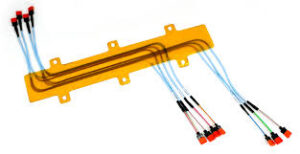
How do flexible printed circuit manufacturers reduce production costs?
Another significant way FPC manufacturers reduce costs is through process optimization. The process of manufacturing flexible circuits involves multiple stages, including etching, lamination, drilling, and testing. By improving these processes and increasing their efficiency, manufacturers can lower both labor and time costs. One method of process optimization is the use of automated equipment. Automation in areas such as etching, drilling, and assembly significantly reduces the need for manual labor and minimizes the risk of human error, both of which can lead to waste and increased costs. Automation also allows for higher production volumes, improving economies of scale and lowering the unit cost of each circuit. For example, automated pick-and-place machines can be used to precisely position components on the circuit, reducing assembly time and increasing throughput.
Design improvements also play a critical role in cost reduction. Manufacturers are continuously developing new techniques and tools to streamline the design process and create more cost-effective FPCs. Design for cost (DFC) principles encourage engineers to design FPCs that are easier and cheaper to manufacture. This may involve simplifying the circuit layout, minimizing the number of layers, or using standard sizes for substrates and components. Modular design is another approach that allows manufacturers to reuse certain components and features across multiple products, reducing the need for custom designs each time. Additionally, using flexible circuits with fewer layers can cut down on the cost of production, as multi-layer designs involve more intricate processes, higher material usage, and increased testing requirements.
FPC manufacturers also focus on reducing defects and rework to minimize waste and associated costs. Defects during the manufacturing process, such as poor etching, misalignment, or component failure, can result in expensive rework or scrap, driving up overall production costs. To mitigate this, manufacturers implement rigorous quality control procedures at various stages of the production process. These may include in-line testing to detect defects early on, reducing the need for expensive repairs later in the process. Statistical process control (SPC) methods are often employed to monitor and control variations in the production process, ensuring consistency and reducing the likelihood of defects. These measures help ensure that the circuits meet quality standards while reducing the chances of costly errors.
Another key cost-saving strategy is the adoption of lean manufacturing principles. Lean manufacturing focuses on eliminating waste, improving workflow efficiency, and maximizing value at every stage of production. By using tools such as value stream mapping, manufacturers can identify inefficiencies and implement changes to reduce downtime, minimize material waste, and streamline production. For example, simplifying the workflow or reorganizing the layout of the production floor can reduce unnecessary movements, lower energy consumption, and improve overall efficiency, all of which contribute to cost reduction.
Finally, economies of scale play a significant role in reducing production costs. By increasing the volume of FPCs produced, manufacturers can spread the fixed costs of equipment, facilities, and design over a larger number of units. This leads to a lower per-unit cost and allows manufacturers to offer competitive pricing. Bulk orders for raw materials, such as copper and polyimide film, also lead to better pricing deals with suppliers, further reducing overall costs.
In conclusion, reducing production costs for flexible printed circuits requires a combination of material optimization, process efficiency, design improvements, quality control, lean manufacturing, and leveraging economies of scale. By continually refining these strategies, FPC manufacturers can offer high-quality products at competitive prices, meeting the demands of various industries while maximizing profitability. Through the use of automation, careful material selection, and the application of advanced manufacturing techniques, manufacturers are able to keep costs under control without sacrificing performance or reliability.
Leave a Reply